

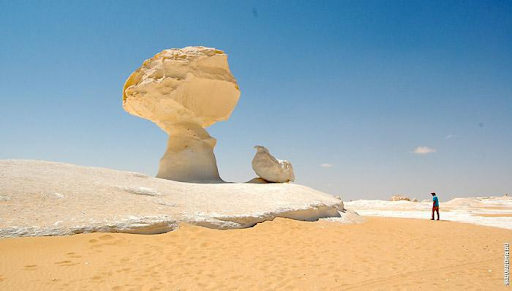
The Egypt Sahara Desert, Earth’s largest hot desert, dominates the Egyptian landscape with an overwhelming presence that has shaped the nation’s history, culture, and identity since prehistoric times. Covering approximately 96% of Egypt’s land area, the Egyptian Sahara represents the northeastern extension of this immense desert system that stretches across North Africa. Far from being a monotonous sea of sand, Egypt’s portion of the Sahara encompasses diverse landscapes, ancient secrets, and ecological systems that continue revealing surprising complexity to modern science.
The Eastern Frontier of an Ancient Desert
Egypt’s relationship with the Sahara is unique among North African nations. While the desert dominates the terrain, the Nile River creates a dramatic contrast, carving a narrow green corridor through the arid expanse. This juxtaposition between fertility and desolation fundamentally influenced ancient Egyptian cosmology, where the “Red Land” of the desert stood in eternal opposition to the “Black Land” of the fertile Nile Valley.
The Egyptian Sahara divides into two principal regions: the Western Desert, comprising the vast Libyan Desert portion of the Sahara, and the Eastern Desert, stretching between the Nile and Red Sea coast. Each possesses distinct geological characteristics, historical significance, and ecological features that distinguish them from one another and from the broader Sahara system.
The Western Desert covers roughly 680,000 square kilometers, making it Egypt’s largest geographical region despite supporting minimal permanent population. This expanse includes the Great Sand Sea, where towering dunes reach heights exceeding 100 meters, the mysterious Gilf Kebir plateau with its prehistoric rock art, and the White Desert’s surreal chalk formations that resemble an alien landscape.
Geological Formation and Landscape Diversity
Understanding the Egyptian Sahara requires appreciating its complex geological history spanning hundreds of millions of years. The region’s current hyper-arid state represents relatively recent development in geological terms. Evidence from multiple scientific disciplines confirms that the Sahara experienced numerous wet and dry cycles throughout the Quaternary period, with the most recent major humid phase ending approximately 5,000 years ago.
Sedimentary rocks dominating the Western Desert preserve evidence of ancient oceans, river systems, and even tropical environments. Fossil discoveries include whale skeletons in Wadi Al-Hitan, now a UNESCO World Heritage Site, documenting when the region lay beneath the Tethys Sea millions of years ago. These findings provide crucial insights into planetary climate evolution and continental drift.
The Eastern Desert presents dramatically different geology. Igneous and metamorphic rocks form rugged mountain chains running parallel to the Red Sea coast. These ancient formations, among Earth’s oldest exposed rocks, contain valuable mineral deposits that attracted mining operations from pharaonic times through the present day. Granite quarries supplied stone for obelisks and statues, while gold mines enriched Egyptian treasuries for millennia.
Volcanic features, though not widely recognized, exist within the Egyptian Sahara. Basalt flows and volcanic cones in the Western Desert testify to past geological activity, creating dark landscapes that contrast starkly with surrounding yellow sands. These formations influence local microclimates and support unique mineral compositions in surrounding soils.
Climate Extremes and Weather Patterns
The Egyptian Sahara experiences some of the planet’s most extreme climatic conditions. Summer temperatures regularly exceed 45°C (113°F), with ground surface temperatures reaching 70°C (158°F) in direct sunlight. Winter nights can drop below freezing in higher elevations, creating temperature swings of 30°C or more within 24-hour periods.
Rainfall arrives sporadically and unpredictably, with most areas receiving less than 25 millimeters annually. Some regions experience years or even decades without measurable precipitation. When rain does fall, it often comes as intense thunderstorms that transform dry wadis into raging torrents within minutes, creating flash floods capable of moving massive boulders and reshaping landscapes.
Wind plays a dominant role in shaping the Egyptian Sahara. The Khamsin, a hot southerly wind occurring primarily in spring, carries enormous quantities of sand and dust northward, reducing visibility to meters and coating everything in fine particles. These wind events can last days, affecting health, transportation, and daily life across the country. Prevailing winds continuously sculpt sand dunes, creating the graceful curves and sharp ridges characteristic of desert landscapes.
Prehistoric Past and Human Occupation
Archaeological evidence reveals that the Egyptian Sahara once supported substantial human populations during wetter climatic periods. Rock art sites scattered across the Western Desert depict cattle, giraffes, elephants, and other animals requiring savanna or woodland habitats. These images, some dating to 10,000 years ago or earlier, document when the region received sufficient rainfall to sustain grasslands and permanent water bodies.
The Nabta Playa site, located in the far southern Western Desert, contains megalithic stone circles and alignments that may represent the world’s oldest known astronomical observatory, predating Stonehenge by over 1,000 years. This sophisticated stone arrangement suggests complex social organization and advanced astronomical knowledge among prehistoric Saharan populations.
As climate shifted toward increasing aridity beginning around 5,300 years ago, populations concentrated along the Nile Valley, contributing to the emergence of Egyptian civilization. This climate-driven migration compressed diverse groups into the narrow fertile corridor, possibly accelerating social complexity and state formation. The desert’s expansion thus played an indirect but crucial role in creating ancient Egypt.
Biodiversity in Extreme Conditions
Despite harsh conditions, the Egyptian Sahara supports specialized ecosystems demonstrating remarkable adaptation. Desert-adapted mammals including fennec foxes, Rüppell’s foxes, and Dorcas gazelles navigate these landscapes using acute senses and physiological adaptations that minimize water loss and maximize heat tolerance. The endangered Nubian ibex inhabits mountainous regions of the Eastern Desert, while various bat species utilize caves and rock crevices as refuges.
Reptilian diversity exceeds mammalian diversity in these environments. Numerous snake species, including several venomous varieties, hunt rodents and other small prey. Lizards adapted to extreme temperatures scurry across scorching surfaces using specialized behaviors and anatomical features that reduce heat absorption. Desert monitor lizards, among the region’s largest reptiles, demonstrate impressive ecological flexibility.
Invertebrate life, though often overlooked, plays essential roles in desert ecosystems. Scorpions, among the most iconic Saharan creatures, possess ancient lineages predating the desert’s formation. Darkling beetles harvest moisture from fog and dew, while various ant species excavate elaborate underground colonies that moderate temperature extremes. These small organisms form the base of food webs supporting larger predators.
Plant communities, necessarily sparse, exhibit extreme drought tolerance. Acacia trees extend roots tens of meters deep accessing groundwater unavailable to surface vegetation. After rare rainfall events, ephemeral plants germinate, grow, flower, and produce seeds within weeks, completing entire life cycles before moisture evaporates. These “desert blooms,” though infrequent, demonstrate latent potential within seemingly lifeless landscapes.
Modern Resource Extraction and Development
The Egyptian Sahara contains valuable natural resources driving modern economic activity. Petroleum and natural gas fields, particularly in the Western Desert, supply significant portions of Egypt’s energy needs. Mining operations extract phosphates, iron ore, and other minerals supporting industrial production. These activities bring employment and infrastructure to remote regions while raising environmental concerns about water usage and habitat disruption.
Solar energy development represents growing interest given the Sahara’s extraordinary sunshine duration. Egypt has constructed major solar facilities in desert regions, harnessing abundant renewable energy to supplement conventional power generation. Ambitious proposals for massive solar installations potentially capable of supplying electricity to Europe continue drawing international attention and investment.
The New Valley Project, a decades-old government initiative, aims to develop agriculture and settlements in Western Desert regions by tapping underground water reserves. While creating new habitable land addresses population pressures along the Nile, critics question sustainability given the non-renewable nature of fossil aquifers. Balancing development aspirations with environmental realities remains contentious.
Adventure Tourism and Desert Exploration
The Egypt Sahara attracts adventurous travelers seeking experiences unavailable in conventional tourist destinations. Desert safaris ranging from single-day excursions to week-long expeditions offer access to remote landscapes, geological wonders, and archaeological sites far from typical tourist circuits. Activities include sandboarding on massive dunes, camping under star-filled skies unpolluted by light, and exploring ancient caravan routes.
Specialized tour operators provide access to restricted areas requiring permits and experienced guides. The Gilf Kebir plateau, setting for the novel “The English Patient,” draws those seeking pristine desert wilderness and world-class rock art. These remote regions demand careful preparation, appropriate equipment, and respect for environmental fragility.
Sustainable tourism development attempts balancing visitor access with conservation. Protected areas including the White Desert National Park implement regulations limiting environmental impact while allowing tourism to continue. Education programs teach visitors about desert ecology, conservation challenges, and responsible behavior minimizing damage to fragile formations and archaeological sites.
Climate Change and Future Challenges
Climate projections suggest the Egyptian Sahara will experience intensifying heat, increased aridity, and more frequent extreme weather events in coming decades. These changes threaten both natural ecosystems and human activities. Wildlife already living at physiological limits may face extinction as habitats exceed tolerance thresholds. Traditional livelihoods in oasis communities risk becoming unsustainable as water resources dwindle.
Desertification along the Sahara’s southern margins receives considerable attention, though the phenomenon affects Egypt’s desert-agriculture boundaries as well. Sand encroachment threatens agricultural land and infrastructure, requiring expensive mitigation measures. Understanding and managing these processes demands ongoing research and adaptive strategies.
Scientific research in the Egyptian Sahara contributes to global knowledge about extreme environments, climate change, and planetary processes. International collaborations study ancient climate records preserved in geological formations, test technologies for extraterrestrial exploration in Mars-analogue environments, and monitor ecosystem responses to environmental change. These investigations yield insights extending far beyond Egypt’s borders.
Conclusion
The Egyptian Sahara stands as one of Earth’s most extraordinary environments, where extreme conditions forge beauty, challenge life, and preserve history across vast timescales. From prehistoric rock art documenting vanished civilizations to modern solar installations harnessing eternal sunshine, this desert tells stories of transformation, adaptation, and human ambition confronting natural limits. As climate change accelerates and development pressures intensify, the Egyptian Sahara faces uncertain futures requiring wisdom, restraint, and innovative approaches balancing human needs with environmental preservation. Understanding and protecting this remarkable desert benefits not only Egypt but contributes to humanity’s broader relationship with the arid lands covering one-third of our planet’s surface.
Frequently Asked Questions
What percentage of Egypt is part of the Sahara Desert? Approximately 96% of Egypt’s total land area consists of the Sahara Desert, making it one of the most desert-dominated countries globally. Only the narrow Nile Valley and Delta, comprising about 4% of the territory, support agriculture and dense population.
Is the Egyptian Sahara all sand dunes? No, sand dunes cover only about 30% of the Egyptian Sahara. The landscape includes rocky plateaus, mountain ranges, gravel plains, salt flats, and various geological formations. The Great Sand Sea contains the most extensive dune fields.
When did the Sahara become a desert? The Sahara has cycled between wet and dry conditions multiple times over millions of years. The current hyper-arid phase began approximately 5,000 years ago, though the region has been generally dry for much longer with periodic humid intervals.
Can you survive in the Egyptian Sahara without water? Survival without water is extremely limited typically less than 24 hours in summer conditions due to extreme heat and dehydration rates. Proper preparation with adequate water supplies is absolutely essential for any desert travel.
What is the hottest temperature recorded in the Egyptian Sahara? While official records vary, temperatures in the Western Desert regularly exceed 50°C (122°F) during summer months, with some reports suggesting higher extremes. Ground surface temperatures can reach 70°C (158°F) in direct sunlight.
